Getting an ecommerce website to rank on Google is very different from optimizing a small business website with ten or twenty pages. An online store can contain hundreds or thousands of products, categories, filters, variations and automatically generated URLs. Every new product can affect the structure of the site, and seemingly minor technical decisions can influence hundreds of pages at once.
This is why the usual advice “add keywords,” “write product descriptions,” “publish blog posts” and “build backlinks” only tells part of the story.
Successful ecommerce SEO is about creating a system in which search engines can easily discover the right pages, understand what each page represents and determine which URLs deserve to rank for specific searches. At the same time, the website needs to make sense to real shoppers and guide them efficiently from search to purchase.
An experienced Ecommerce SEO expert therefore doesn’t start by asking, “Where can we add more keywords?” The better questions are: Which pages should rank? Which pages shouldn’t be indexed at all? Where is authority being lost? Are category pages targeting real commercial demand? And is organic traffic actually generating revenue?
Below are some of the ecommerce SEO strategies and problems that often receive far less attention than they deserve.
1. Stop Optimizing Every Product Page and Start With Search Intent
One of the biggest mistakes ecommerce businesses make is assuming that every important keyword should lead to a product page.
Search intent doesn’t work that way.
Someone searching for “best waterproof hiking shoes” is probably still comparing options. A search for “women’s waterproof hiking shoes” may indicate category-level intent, while someone searching for a specific model, brand and size is much closer to a product-level purchase.
Google attempts to understand these differences.
If the search results for a keyword are dominated by category pages, trying to rank an individual product for that query may be an uphill battle regardless of how well the product description is optimized.
This is why ecommerce keyword research should start by mapping intent to page type, rather than simply assigning keywords to whichever page seems convenient.
| Search Type | Example | Best Page Type |
| Broad commercial | men’s running shoes | Category |
| Specific commercial | waterproof trail running shoes | Subcategory |
| Product | Nike Pegasus 41 black | Product page |
| Comparison | Nike Pegasus vs ASICS Novablast | Guide/comparison |
| Informational | how to choose running shoes | Blog/buying guide |
This distinction matters because ecommerce SEO is not simply about ranking more pages. It is about ranking the right page for the right query.
Before creating additional content, examine the existing Google results for your target keywords. Look at the types of pages Google is already rewarding. This simple exercise can prevent months of optimizing the wrong URLs.
2. Your Category Pages Could Be Your Most Valuable SEO Assets
Product pages naturally receive a lot of attention because that’s where transactions happen. From an organic search perspective, however, category and subcategory pages can be considerably more valuable.
A category can target broader commercial demand while presenting shoppers with multiple choices.
For example, an ecommerce store selling furniture might have a category for “office chairs.” But deeper keyword research may reveal substantial demand around terms such as ergonomic office chairs, leather office chairs, home office chairs and executive office chairs.
Creating useful subcategories around genuine demand can expand organic visibility while simultaneously making the store easier to navigate.
The important word here is genuine.
Creating hundreds of nearly identical categories simply to target keyword variations isn’t a smart strategy. Each indexable category should serve a meaningful purpose for shoppers and have enough relevant products to justify its existence.
A strong category page may include a concise introduction, relevant products, useful filtering, descriptive headings, FAQs or buying information where appropriate, and internal links to closely related categories.
It doesn’t necessarily need 1,500 words of text underneath the products.
The goal isn’t to turn category pages into blog articles. The goal is to give Google enough context to understand the category while preserving the shopping experience.
This is one area where an SEO expert for website optimization needs to understand ecommerce specifically. A content strategy that works perfectly for a service business may be completely inappropriate for an online store.
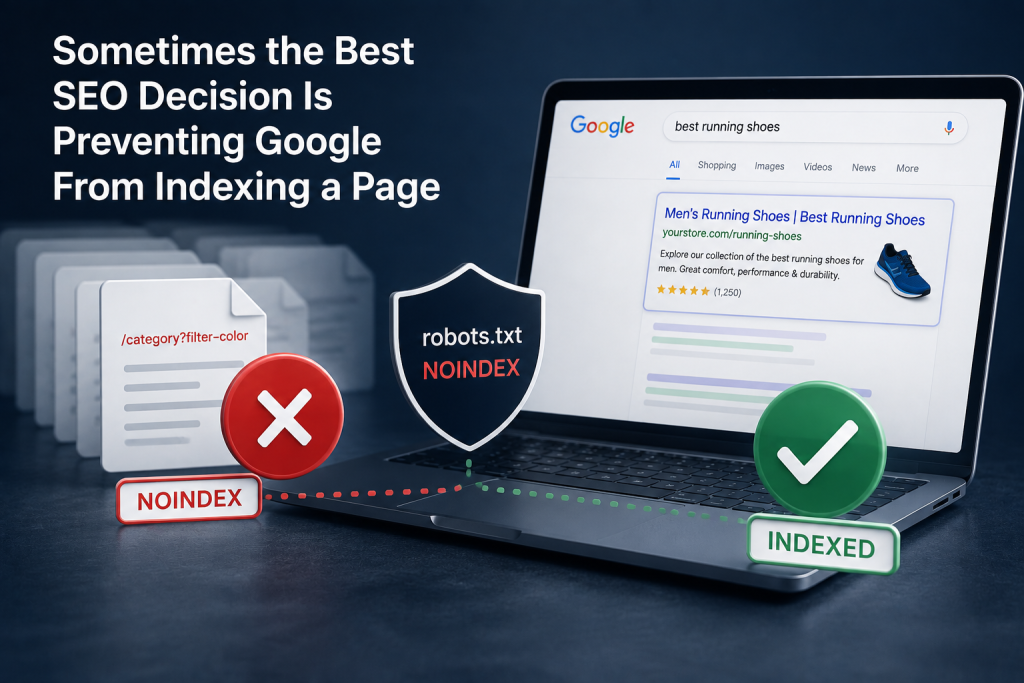
3. Sometimes the Best SEO Decision Is Preventing Google From Indexing a Page
SEO is usually presented as a race to get more pages indexed.
For ecommerce websites, the opposite can sometimes be true.
Imagine your store contains 5,000 products, but Google has discovered 150,000 URLs.
That discrepancy should immediately raise questions.
Large ecommerce platforms can generate huge numbers of URLs through filters, sorting parameters, pagination, tracking parameters, internal search results, product variants and combinations of all of the above.
Consider a category containing 200 shoes. Users might filter by:
- Brand
- Size
- Colour
- Price
- Gender
- Material
Those filters are useful for customers. But if every possible combination creates a crawlable or indexable URL, one category can potentially generate thousands of URL variations.
This phenomenon is often referred to as index bloat.
The problem isn’t simply that Google sees “too many pages.” The bigger issue is that search engines may spend resources crawling low-value URLs while your strategically important products and categories compete for attention.
There is no universal rule saying that all filtered URLs should be blocked. Some filtered combinations may represent valuable search demand.
For example, if people regularly search for “black leather office chairs,” a dedicated landing page for that combination could make excellent SEO sense.
But a URL representing “black office chairs sorted price-low-to-high page 4” probably doesn’t deserve its own search result.
This is where ecommerce SEO becomes strategic rather than mechanical.

4. Internal Linking Is Quietly Deciding Which Pages Matter
Backlinks receive enormous attention in SEO. Internal links usually receive much less.
That’s a mistake.
Google uses links to discover pages and understand relationships between them. Your internal linking structure also provides clues about which pages you consider important.
Imagine you have two product categories with equal commercial value.
The first is linked directly from your main navigation, referenced by several buying guides and connected to related categories.
The second is buried four levels deep and receives almost no internal links.
Even if both pages contain excellent content, you’re sending very different signals about their importance.
A strong ecommerce internal linking strategy doesn’t mean adding dozens of keyword-rich links everywhere. It means creating logical paths between related content.
A buying guide about choosing a coffee machine might naturally link to espresso machines, automatic coffee machines and relevant accessories. Those categories can, in turn, direct users toward useful guides when additional information can help them make a purchasing decision.
This creates something extremely valuable: context.
Instead of Google encountering thousands of isolated URLs, it encounters clusters of related products, categories and information.
Internal links also allow authority earned by strong pages to flow deeper into the site. A blog article that earns external backlinks shouldn’t become a dead end. Where appropriate, some of that authority can be passed toward commercially important pages through relevant internal links.
For large stores, internal linking isn’t housekeeping. It’s part of the SEO architecture.
5. Don’t Automatically Delete Products That Are No Longer Available
What happens when a product sells out?
For many ecommerce platforms, the answer is surprisingly destructive: the product disappears and the URL returns a 404.
That might be fine for a product that was live for three days and never generated traffic. But what if the page has ranked on Google for two years, attracted backlinks and receives hundreds of organic visits?
Deleting it means potentially throwing away accumulated SEO value.
The correct solution depends on why the product is unavailable.
| Product Situation | Possible SEO Approach |
| Temporarily out of stock | Keep page live and communicate availability |
| Returning soon | Keep URL and offer notification option |
| Permanently discontinued with close replacement | Consider relevant redirect |
| Discontinued but still searched heavily | Keep useful page and suggest alternatives |
| No traffic, links or replacement | Removal may be appropriate |
There isn’t a single rule for every discontinued product.
That’s the important part.
Blindly redirecting every deleted product to the homepage isn’t good SEO either. A visitor searching for a particular laptop shouldn’t suddenly land on a generic electronics homepage with no explanation.
SEO decisions should preserve both user intent and accumulated URL value whenever possible.
6. Your Own Customers Can Reveal Keywords Your SEO Tools Miss
Keyword research platforms are extremely useful, but they shouldn’t be your only source of information.
One of the most interesting datasets available to ecommerce businesses often sits inside the website itself: internal site search.
What are customers searching for after they arrive?
Suppose you operate an online pet store and discover that visitors repeatedly search for “grain-free senior dog food.” You sell suitable products, but there is no dedicated category or landing page for that need.
That’s useful information.
Your customers have effectively identified a possible content or category gap.
Internal searches can reveal terminology customers actually use, missing product attributes, brands users expect you to carry, common spelling variations and combinations of features that deserve better navigation.
Another valuable source is customer service.
Questions repeatedly asked through email, live chat, WhatsApp or sales calls can often become:
- Product FAQs
- Buying guides
- Category content
- Comparison pages
- Product-page information
This creates content from real customer demand, rather than content created simply because an SEO tool reported search volume.
And that difference matters increasingly as Google focuses on helpful content and AI-powered discovery systems attempt to surface direct, useful answers.
7. More Organic Traffic Is Not Always Better Ecommerce SEO
Traffic is one of the easiest SEO metrics to celebrate.
“Organic traffic increased 80%!”
It sounds impressive.
But what happened to revenue?
Consider two organic landing pages:
| Page | Monthly Organic Traffic | Conversion Rate | Revenue Impact |
| Blog article | 25,000 | 0.1% | Low |
| Product category | 3,500 | 4.2% | High |
The article may look like the clear SEO winner in Google Analytics. From a business perspective, the category could be considerably more valuable.
This doesn’t mean informational content is useless. Far from it. Good educational content can introduce users to the brand, earn links, build topical authority and influence purchases later in the journey.
But ecommerce SEO should never be measured using traffic alone.
A mature SEO strategy should connect organic visibility to commercial outcomes such as organic revenue, conversion rate, average order value, assisted conversions and performance by landing-page type.
You should also distinguish between branded and non-branded searches. Growth driven entirely by people already searching for your company name tells a very different story from growth generated through new product and category searches.
This is one reason why finding the best SEO expert for ecommerce website growth isn’t about finding someone who promises the largest traffic increase.
A good specialist should understand the difference between traffic that looks impressive in a report and traffic that actually grows the business.
8. Product Content Should Help People Buy Not Satisfy a Word Counter
There was a period in SEO when “write more content” became the answer to almost everything.
That thinking produced some terrible ecommerce pages.
You have probably seen them: a category page with products at the top followed by 2,000 words of repetitive text written almost entirely for Google.
That’s not a great shopping experience.
The same applies to product descriptions. A 700-word description isn’t inherently better than a 150-word description.
Useful product content depends on what someone needs before purchasing.
For a technical product, customers may need detailed specifications and compatibility information. Clothing shoppers may need size guides, materials, care instructions and fit information. Furniture buyers may need dimensions, delivery information and assembly details.
Think about information completeness rather than word count.
High-quality product pages may combine:
- Clear original descriptions
- Accurate specifications
- Product availability
- Original imagery
- Video when useful
- Genuine customer reviews
- FAQs
- Delivery and returns information
- Comparisons or alternatives
This content also provides clearer information for search engines and AI systems trying to understand the product.
The principle is simple: answer the questions that stand between the customer and the purchase.
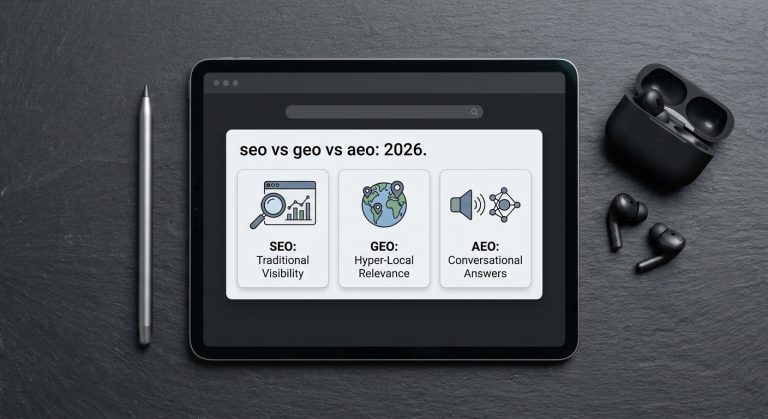
9. Ecommerce SEO Is Becoming SEO + AI Visibility
For years, ecommerce search optimization had a relatively straightforward destination: Google.
That’s changing.
Consumers increasingly use AI-powered search and answer platforms to research products, compare brands and understand purchasing options. Google itself is integrating AI-generated experiences into search.
This doesn’t mean traditional SEO is disappearing.
It means the definition of search visibility is expanding.
An ecommerce website now benefits from making its information exceptionally easy for machines to understand.
Clear product names, consistent brand information, accurate specifications, descriptive categories, structured data, logical internal relationships and authoritative supporting content all contribute to that goal.
For example, imagine someone asks an AI assistant:
“What should I look for when buying a standing desk for a small home office?”
A retailer with nothing but thin product pages provides limited useful information.
A retailer that has strong product data, detailed categories, buying guides, comparisons, FAQs and clearly connected content provides much more context about its expertise and inventory.
That doesn’t guarantee an AI platform will mention the store. No legitimate ecommerce SEO expert should promise that.
But building content that is structured, factual, authoritative and easy to interpret gives search systems more useful information to work with.
The future of ecommerce SEO is therefore unlikely to be “Google versus AI.”
It is more likely to be about building a digital presence that can be understood across Google Search, AI-generated search experiences and conversational discovery platforms.
10. Before Creating More Content, Find What Is Almost Ranking
One of the fastest SEO opportunities may already exist inside your website.
Businesses often focus on finding completely new keywords. Meanwhile, valuable category or product pages may already rank between positions 5 and 15.
These URLs deserve attention.
A page sitting at position 11 for a commercially valuable keyword has already demonstrated some degree of relevance. Moving it several positions upward may produce meaningful traffic without creating a new URL from scratch.
Analyse whether the page truly satisfies the current search intent. Compare it with pages ranking above it. Look at product selection, content, internal links, titles, usability, backlinks and technical implementation.
Sometimes the solution is surprisingly small.
Perhaps the category isn’t linked prominently enough. Maybe its title doesn’t accurately reflect the products. Perhaps competing pages offer a better product selection or answer an important customer question yours ignores.
SEO isn’t always about expansion.
Sometimes it is about making your existing assets work harder.
What Should an Ecommerce SEO Expert Actually Look At?
When businesses hire an SEO professional, they sometimes expect the process to begin with a list of keywords.
For ecommerce, that is only one component.
A proper ecommerce SEO strategy should examine the entire relationship between technical accessibility, search demand, architecture, content and commercial performance.
| Area | What Should Be Evaluated? |
| Technical SEO | Crawling, indexing, canonicals, sitemaps, speed |
| Site Architecture | Categories, subcategories, crawl depth |
| Keyword Strategy | Commercial intent and page mapping |
| Product SEO | Product data, content, schema, availability |
| Internal Links | Authority distribution and discoverability |
| Content | Buying guides, comparisons, FAQs |
| Authority | Relevant backlinks and brand mentions |
| Performance | Traffic, conversions and organic revenue |
| AI Visibility | Clear entities, structured information, useful answers |
This is also why an SEO expert for website optimization who mainly works with small lead-generation sites may not automatically have the experience required for a large ecommerce operation.
Platforms such as Shopify, WooCommerce and Magento introduce their own technical considerations, while large product inventories create challenges around crawling, duplicate content, filters and inventory changes.
If you’re searching for the best SEO expert for ecommerce website optimization, ask how they approach these problems rather than simply asking how many keywords they can rank.
Their answers will tell you far more than a promise of “page-one rankings.”
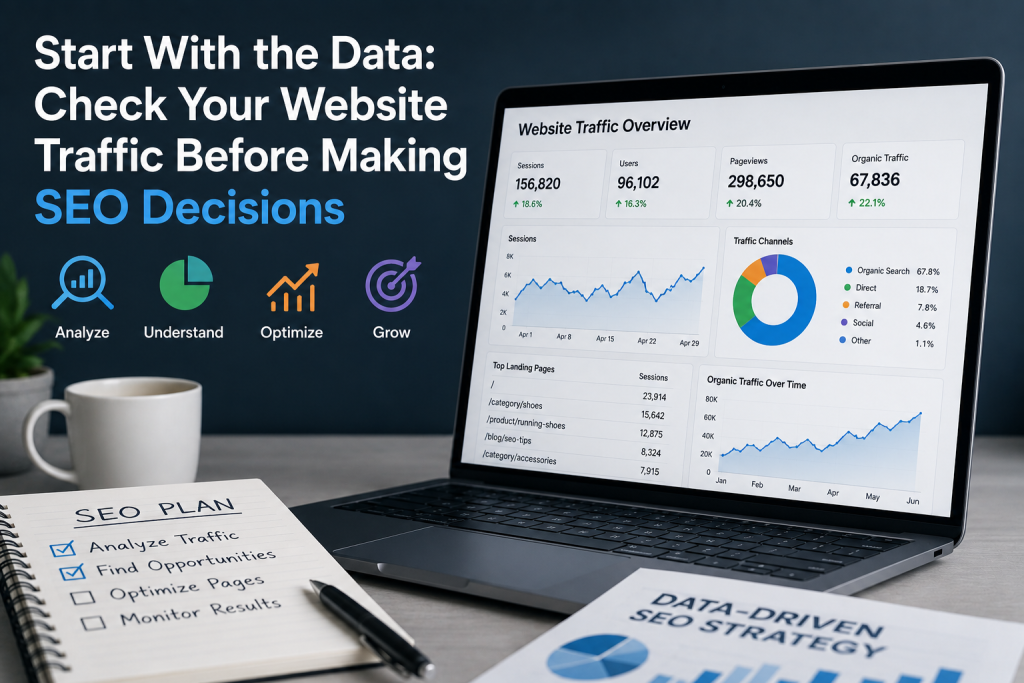
Start With the Data: Check Your Website Traffic Before Making SEO Decisions
Before changing category structures, rewriting product descriptions or investing in new content, it is important to understand where your ecommerce website currently stands. Website traffic data provides a useful starting point for identifying whether organic visibility is growing, which pages are attracting visitors and where potential opportunities may exist.
A Website Traffic Checker can help you get a quick overview of a website’s traffic performance and can be particularly useful when comparing your store with competitors. Instead of making SEO decisions based entirely on assumptions, traffic analysis gives you additional context for deciding where to focus your efforts.
For ecommerce businesses, the most interesting question isn’t simply “How much traffic does my website get?” A better question is “Which parts of my website have the potential to generate more valuable organic traffic?”
For example, you might discover that a competitor attracts significantly more visibility despite offering a similar product range. That observation gives you a starting point for deeper analysis: Are their category pages stronger? Do they cover search intent you are missing? Is their website architecture easier for Google to understand? Do they have more useful supporting content or a stronger authority profile?
This is how an experienced ecommerce SEO expert uses traffic data. The number itself is only the beginning. The real value comes from turning that information into actionable SEO decisions.
Regularly checking website traffic can also provide a useful benchmark as your strategy develops. Combine traffic insights with Google Search Console, analytics, keyword data, link analysis and revenue metrics to understand not only whether visibility is increasing, but whether SEO is attracting the right audience to the right ecommerce pages.
Final Thoughts: The Best Ecommerce SEO Often Happens Behind the Scenes
The most valuable ecommerce SEO improvements aren’t always visible.
Customers won’t notice that you fixed canonicalization across 20,000 URLs.
They probably won’t know that you reorganized internal links so Google can reach important categories more efficiently.
They won’t see the indexation strategy that prevents thousands of useless filter combinations from entering search results.
But search engines will encounter a cleaner, more understandable website and customers may ultimately benefit from better navigation and more relevant landing pages.
That’s what makes ecommerce SEO different.
Success isn’t created by finding one secret keyword or adding the phrase “best running shoes” to another product description. It comes from aligning website architecture, technical SEO, search intent, useful content, internal linking, authority and commercial goals.
So before publishing another 50 articles or rewriting 1,000 product descriptions, examine the system behind your store.
Which pages are Google actually indexing? Which categories have real search demand? Where is internal authority flowing? Which URLs generate revenue? What questions do customers repeatedly ask? And are you making it easy for both search engines and emerging AI platforms to understand exactly what your business offers?
Those are the ecommerce SEO questions worth answering. And they are often the ones nobody tells you about.
If you want your online store to compete beyond traditional Google rankings, GeoBroo can help you build a smarter ecommerce SEO strategy that combines technical SEO, content, data, and AI Search Optimization. We focus on increasing the right organic traffic, strengthening your store’s visibility, and preparing your ecommerce website for the way customers search today across Google and AI-powered platforms.
Ready to grow your ecommerce store with SEO and AI? Contact GeoBroo and let’s build a strategy designed around your products, your market, and your growth goals