SEO vs GEO vs AEO in 2026: What’s Changed?
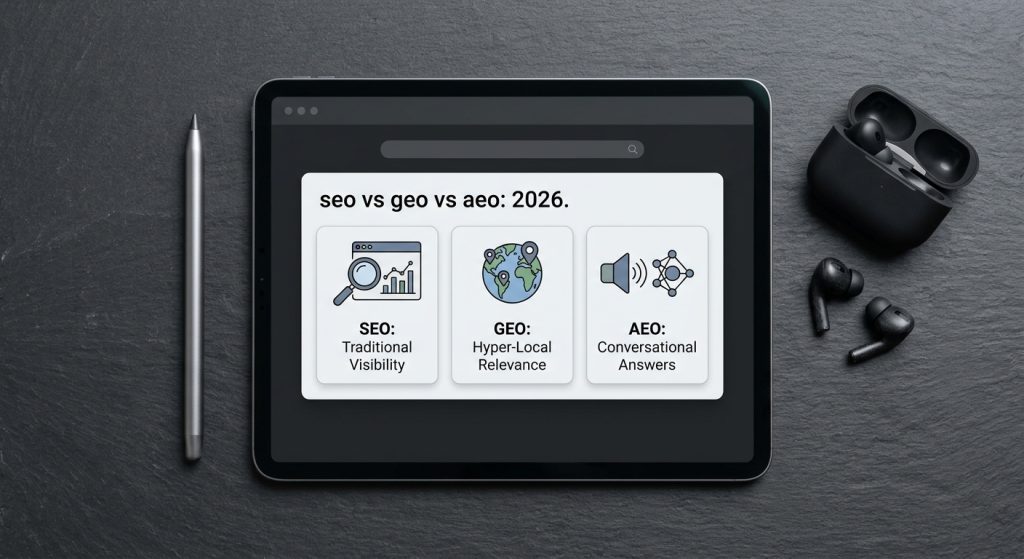
The digital marketing landscape is a perpetual motion machine, constantly evolving. If you’re still thinking about SEO, GEO, and AEO the way you did even a couple of years ago, you’re likely missing out on critical opportunities in 2026. This article delves into the nuances, shifts, and enduring principles of these three crucial acronyms.
Understanding the distinctions and overlaps between SEO, GEO, and AEO is more vital than ever for businesses aiming to cut through the noise. With AI-driven search becoming the norm and user intent growing increasingly sophisticated, a holistic strategy is no longer optional but essential for visibility and conversion. Let’s explore what’s actually changed and what still works in the dynamic world of digital visibility.
For a deeper dive into how these strategies intertwine and how to implement them effectively, especially as we navigate 2026 and beyond, explore the comprehensive guide on seo vs geo vs aeo. This resource provides actionable insights into leveraging each component for maximum impact in your digital campaigns.
Search Engine Optimization (SEO) in the Age of AI
SEO, or Search Engine Optimization, remains the bedrock of online visibility, but its definition has significantly broadened by 2026. The shift from keyword-stuffing to semantic understanding and user experience (UX) has accelerated, driven largely by advancements in AI and machine learning algorithms from major search engines like Google and Bing. Core Web Vitals, now encompassing a wider array of user interaction metrics beyond just load times, play an even more critical role.
Content quality has become paramount, emphasizing expertise, authoritativeness, and trustworthiness (E-E-A-T). AI-generated content, while a powerful tool for scale, must be meticulously reviewed and enhanced by human experts to meet these elevated standards. Search engines are increasingly adept at discerning truly valuable, original content from mass-produced, low-quality output. Therefore, SEO in 2026 is less about tricking algorithms and more about genuinely serving user needs with high-quality, relevant, and accessible information.
Technical SEO also continues to evolve, with mobile-first indexing being a long-established standard. The rise of new content formats, such as immersive 3D experiences and interactive rich media, demands new approaches to crawlability and indexability. Structured data, particularly Schema.org markups, is more important than ever for helping search engines understand the context and purpose of your content, leading to richer snippets and better visibility in diverse search results.
Geographic Optimization (GEO): Hyper-Local Dominance
Geographic Optimization (GEO) has moved beyond simple local keyword targeting to a sophisticated understanding of user location, intent, and proximity in 2026. With nearly 70% of all searches now having some local intent, even if not explicitly stated, GEO strategies are indispensable. Google Business Profile (formerly GMB) remains central, but its optimization now involves more dynamic elements like real-time updates, AI-driven review analysis, and integration with local service ads that leverage live location data.
The proliferation of voice search and augmented reality (AR) applications has further amplified the importance of GEO. Users frequently ask “near me” questions or seek directions using voice assistants, making accurate, up-to-date local listings and schema markup for addresses, opening hours, and service areas absolutely critical. For instance, a coffee shop’s GEO strategy in 2026 isn’t just about ranking for “coffee shop near me,” but also about appearing in AR overlays when someone points their phone at a street, or being suggested by an AI assistant based on their past preferences and current location.
Beyond traditional listings, GEO now encompasses local content strategies that resonate with specific community interests and events. This might involve creating blog posts about local festivals, sponsoring community initiatives, or engaging with local influencers. The goal is to establish a strong local digital footprint that reflects real-world engagement and builds trust within specific geographic areas. Local link building, from community websites and local news outlets, also carries significant weight, signaling relevance to search engines.
Answer Engine Optimization (AEO): The Future of Discovery
Answer Engine Optimization (AEO) is arguably the most transformative development impacting search in 2026. With the pervasive integration of AI chatbots, voice assistants, and generative AI directly into search interfaces, users are increasingly seeking direct answers rather than lists of links. AEO is about optimizing your content to be the definitive, concise, and accurate answer that an AI assistant or search generative experience (SGE) will pull and present to a user.
This paradigm shift means that simply ranking #1 for a keyword might not be enough if an AI summarizes an answer from a competitor’s site directly within the search results. AEO demands a focus on clear, unambiguous language, structured content that directly addresses common questions (often in Q&A formats), and a strong emphasis on factual accuracy and data validation. Think about how you’d explain a concept to an AI: simple, direct, and authoritative.
By 2026, many search queries are resolved without the user ever clicking through to a website. This means capturing “zero-click” answers is a primary AEO goal. Strategies include optimizing for featured snippets, crafting comprehensive FAQ sections, and ensuring your content directly answers the “who, what, when, where, why, and how” for your target audience. The rise of multimodal AI also means optimizing for visual and audio answers, not just text, preparing for a future where search results might be a spoken response or an interactive visual.
The Evolving Interplay: SEO vs GEO vs AEO
In 2026, the discussion isn’t truly about “seo vs geo vs aeo” as competing strategies, but rather how they intricately weave together to form a comprehensive digital visibility strategy. You can’t have effective AEO without strong foundational SEO, ensuring your content is discoverable and credible. Similarly, GEO is a specialized branch of SEO, focusing on location-specific relevance, but it also increasingly leverages AEO principles to provide direct, locally-relevant answers to user queries.
Consider a user asking their AI assistant, “What’s the best vegan restaurant near me that’s open late tonight?” This single query requires a blend of all three: strong SEO for the restaurant’s general online presence and authority, robust GEO to identify its location and operating hours, and sophisticated AEO to ensure its menu, reviews, and specific offerings are presented as the “best” and directly answer the “vegan” and “open late” criteria. A truly effective digital strategy in 2026 integrates these elements seamlessly.
The lines blur further with personalized search experiences. AI algorithms now factor in a user’s past search history, location, device, and even emotional tone to deliver highly tailored results. This means your content needs to be optimized not just for a generic search, but for a multitude of potential personalized queries, making the synergy between SEO, GEO, and AEO more critical than ever. Businesses that excel will be those that understand this interconnectedness and build strategies that leverage each component for holistic growth.
Crafting a Unified Digital Visibility Strategy for 2026
Moving forward, a successful digital visibility strategy in 2026 demands a unified approach that doesn’t silo SEO, GEO, and AEO. Start with a solid SEO foundation: ensure your website is technically sound, fast, mobile-friendly, and provides an excellent user experience. Produce high-quality, E-E-A-T-compliant content that genuinely solves user problems and answers their questions comprehensively. This forms the bedrock for everything else.
Frequently Asked Questions
What are the main benefits of this topic?
The main benefits include improved performance, time savings, and better overall results.
How do you get started with this topic?
Start by learning the basics, choosing the right tools, and implementing step by step.
How long does it take to see results?
Typically 30–90 days, depending on your effort and the strategy you choose.
What are the common mistakes to avoid?
Common mistakes include lack of planning, unrealistic expectations, and not tracking results.
Is this topic suitable for everyone?
Yes, with the right preparation and tools, this topic is accessible to anyone.