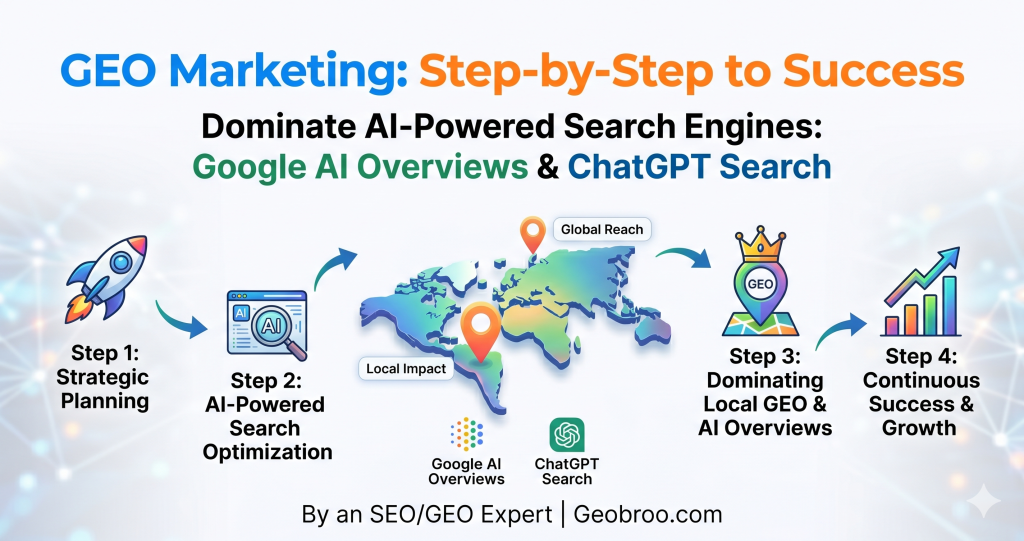
GEO Marketing: Step-by-Step to Success
How to Dominate AI-Powered Search Engines Google AI Overviews, ChatGPT Search & Beyond
By an SEO/GEO Expert | Geobroo.com
The Search Landscape Has Permanently Changed
If you’re still optimizing exclusively for the blue-link SERP of 2019, you’re fighting yesterday’s war.
In 2024–2025, the battleground shifted. Google’s AI Overviews now summarize answers before users ever see a single organic result. ChatGPT Search processes millions of queries daily, pulling citations from across the web. Perplexity AI is rapidly becoming the research tool of choice for high-intent users. And Bing Copilot is embedded directly into Windows 11 for hundreds of millions of users worldwide.
This isn’t a future threat it’s the present reality.
Generative Engine Optimization (GEO) is the discipline that bridges traditional SEO with the unique citation mechanics of AI-powered search. Done correctly, it doesn’t replace your existing SEO strategy it amplifies it, positioning your content as a primary source that large language models (LLMs) trust, cite, and surface to their users.
This is your step-by-step framework to succeed in the new AI search era.
Step 1: Understand How AI Search Engines Select Their Sources
Before you optimize, you must understand the mechanism. Traditional SEO is driven by crawlability, backlink authority, and keyword relevance. AI search operates on a fundamentally different logic: trustworthiness, semantic clarity, and citation-worthiness.
LLMs are trained on vast datasets and then retrieve live web content via RAG (Retrieval-Augmented Generation) pipelines during inference. When ChatGPT Search, Perplexity, or Google AI Overviews pull a web source, they’re evaluating:
- Entity authority: Is this brand/website established as a subject-matter expert?
- Semantic coherence: Does the page directly, comprehensively answer a specific question?
- Structural accessibility: Is the content structured in a way that a model can extract and attribute cleanly?
- Citation signal: Do other authoritative sources reference this domain or content?
The practical implication: AI systems favor informational depth over keyword density, and structural clarity over creative prose.
Step 2: Build Your Topical Authority Architecture
The single most impactful GEO strategy is Topical Authority Clustering — and it maps almost perfectly onto what Google’s Helpful Content system rewards.
How it works: Create a comprehensive pillar-and-cluster content architecture around your core topic. For an SEO agency like Geobroo, this means:
- Pillar Page: “The Complete Guide to GEO (Generative Engine Optimization)”
- Cluster Pages: What is GEO?, GEO vs SEO, GEO for E-commerce, GEO for Local Businesses, How to Optimize for ChatGPT, How to Appear in Google AI Overviews, GEO Tools & Audits, etc.
When your domain comprehensively covers a topic from every angle, AI systems begin to treat it as a knowledge hub. They’re more likely to pull from a source that clearly owns the subject matter, rather than a single well-written post floating in a thin content ecosystem.
Action items:
- Map every sub-topic, question, and intent within your niche
- Ensure internal linking connects clusters explicitly to pillar pages
- Use consistent entity language across all pages (same terminology, brand names, technical terms)
Step 3: Optimize Content Structure for Machine Extraction
AI systems parse content differently than humans read it. They look for extractable, attributable facts clean statements that can be surfaced in a generated answer with a citation link attached.
Structural GEO best practices:
Use clear H2/H3 hierarchies. Every section should answer one discrete question. AI models map heading text directly to query intent your H2 is your answer label.
Lead with the answer, then elaborate. Inverted pyramid writing isn’t just good journalism it’s how AI models extract answers. Don’t build up to your key insight; state it immediately, then support it.
Deploy definition blocks and FAQ sections. Schema-marked FAQ sections are among the highest-cited content types in Google AI Overviews. A clean “What is X?” section at the top of a page is pure GEO fuel.
Use numbered and bulleted lists for processes. Step-by-step structures are extracted nearly verbatim by AI systems. If you’re explaining a process, number it.
Include statistics with sources. AI systems give citation preference to pages that reference verifiable data. Original research, properly cited third-party statistics, and industry data points dramatically increase citation frequency.
Step 4: Win the E-E-A-T Signal Game
Google’s E-E-A-T (Experience, Expertise, Authoritativeness, Trustworthiness) framework is the human-legible representation of what LLMs algorithmically evaluate. You cannot optimize for AI search without building genuine E-E-A-T signals.
Experience: Publish real case studies, project breakdowns, before/after data, and client results. AI systems can distinguish generic content from practitioner-authored content.
Expertise: Use precise technical vocabulary. Write at the level of a peer, not a beginner. AI systems trained on professional literature recognize domain-specific language and weight it accordingly.
Authoritativeness: Earn mentions, links, and citations from established industry publications. Being referenced by Search Engine Journal, Moz, or Search Engine Land tells both Google and ChatGPT that your domain is a canonical source.
Trustworthiness: HTTPS, clear author bios with credentials, transparent privacy policies, and no affiliate-stuffed thin content. AI systems penalize what they perceive as low-trust domains.
Step 5: Target Conversational, Long-Tail, and Question-Based Queries
Traditional SEO optimizes for head keywords. GEO optimizes for conversational intent.
Users interacting with AI search engines write in natural language: “What’s the best way to optimize a local business for ChatGPT search in 2025?” not “ChatGPT local SEO tips”.
This fundamentally changes keyword research. Your GEO keyword strategy must include:
- “How to” queries: Procedural content is the most cited content type in AI Overviews
- Comparison queries: “X vs Y” pages earn consistent AI citations
- Definition queries: “What is [technical term]” pages are extremely high-citation targets
- Local + intent queries: “Best [service] in [city]” AI engines now synthesize local packs with generative summaries
Tool recommendation: Use tools like AlsoAsked.com, AnswerThePublic, and People Also Ask data to mine conversational query clusters. These mirror exactly what AI models are trained to answer.
Step 6: Implement Structured Data and Schema Markup
Structured data is the clearest signal you can send to both Google’s AI systems and third-party LLM crawlers. It translates your content into a machine-readable semantic layer.
Prioritize for GEO:
FAQPageschema on every informational pageHowToschema on process-driven contentArticle/BlogPostingwithauthorentity markupOrganizationschema on your homepage with complete NAP and social profilesBreadcrumbListfor topical hierarchy signaling
Properly implemented schema tells AI models exactly what type of content they’re reading, which query intents it serves, and which entity authored it. It’s the difference between being indexed and being understood.
Step 7: Monitor Your AI Search Visibility and Iterate
GEO without measurement is guesswork. You need to track:
- AI Overview impressions in Google Search Console (segment by query type)
- Branded query growth AI citations drive brand awareness, which shows up in branded search volume
- Referral traffic from AI sources ChatGPT Search, Perplexity, and Bing Copilot pass referral signals in GA4
- Citation monitoring Tools like BrandMentions and manual ChatGPT/Perplexity spot-checks for your target queries
Run quarterly GEO audits on your top 20 target queries. Test each in ChatGPT, Perplexity, and Google AI Overviews. Track whether your domain appears in citations. If it doesn’t, reverse-engineer which source does appear and build content that is measurably more comprehensive.
The Compounding Advantage
Here’s the professional insight most marketers miss: GEO compounds with SEO. The same content improvements that make you more visible in AI Overviews deeper topical coverage, cleaner structure, stronger E-E-A-T also increase your organic rankings. The strategies reinforce each other.
The agencies and brands building their GEO foundations today are creating moats that will be nearly impossible to overcome in 24 months. AI search share is growing at double digits quarter over quarter. The window to establish first-mover authority is open right now but it won’t stay open forever.
Execute the seven steps above with discipline, measure relentlessly, and iterate faster than your competitors. That’s how you don’t just survive the AI search revolution you lead it.
Want a full GEO&SEO Free Audit of your website? → geobroo.com